Wednesday, 9 January 2013

Book Review - Dog Company by Patrick K. O'Donnell

Being a military history guy, I love books that give the history of World War II (or any other war, really) in broad strokes, giving the whys and the hows, what the strategies were, that sort of thing.

But I also love looking at smaller parts of the war. What were individual soldiers thinking? What was happening in that one small village that the squad was supposed to patrol?

Patrick K. O'Donnell seems to specialize in the small, with books that talk about individual units and that come out of conversations and interviews with those who were involved. I had previously read and reviewed The Brenner Assignment (one that didn't make it on this site, so I will rectify that next week), so it was a natural that I would snap up O'Donnell's latest, Dog Company.

This is the story of the Army Rangers who stormed the cliffs of Pointe du Hoc during the Normandy landings. That's right.: they scaled sheer cliffs under withering fire to knock out a set of guns that were overlooking the beaches that could rain shells down on those heading for the beaches.

It's not just a story of Normandy, though. It's the story of courage, heroism, even desperation as they are later tasked with taking and defending a lonely hill in a German forest, one of the most needless (and thus even more costly, as the lives were given away for nothing) battles of World War II.

My review of it has gone live on Curled Up With a Good Book.

From the review:
"O'Donnell interviewed most (if not all) of the survivors of Company D (Dog Company), the Rangers who were tasked with the most difficult missions in the Western European conflict. They first became famous for being charged with destroying the massive German guns on the cliffs of Pointe Du Hoc overlooking the beaches where Allied troops would be storming ashore. To do so, they would have to scale sheer surfaces with little to no protection. The bravery of these men radiates, from the cliff-climbing training in Great Britain to the lead-up to the fateful assault.

The narrative then moves on to the Hurtgen Forest, one of the most unnecessary battles of the war and one that cost many American lives. For months, the members of Dog Company are cut down right and left in small villages or among the trees. You can almost feel the air bursts of mortars as they send shrapnel and bits of tree slicing through the soldiers. Finally, O'Donnell talks about Dog's role in the Battle of the Bulge and the crossing of the Roer River."
The fact that this is done almost totally through interviews, as part of O'Donnell's "Drop Zone" living history project (a wonderful site that you should explore to keep these heroes memories alive) makes this book even more immediate than it would be otherwise.

It's an excellent book and one I'm very glad that I read.

Monday, 7 January 2013

Star Trek: DS9 - Ep 16 - The Forsaken

I have to be upfront about something. I can't stand Lwaxana Troi (Majel Barret). I disliked every episode of Star Trek: The Next Generation that she was on, bar one. I find nothing funny or alluring about her and how she becomes a man-chasing harlot. If I see that she's in an episode, I cringe. So when I saw that she was going to be in a Deep Space Nine episode, I was horrified. After having seen "The Forsaken," I have to say that even this cast couldn't save it. Don't get me wrong, there are a couple of moments in there, moments where I wasn't sorry I was watching it (see what I do for you?). But those moments were few and far between.

Four ambassadors have come to the station to see the wormhole. Dr. Bashir (Siddig El Fadil) has been assigned to escort three of them around the station, and he's having a hard time of it. He just can't make them happy, and they're starting to get perturbed about how Commander Sisko (Avery Brooks) is avoiding them. The fourth, however, doesn't seem to mind. It's Lwaxana Troi, and she has formed an attachment to security chief Odo (Rene Auberjonois) after he finds a brooch that had been stolen from her. This fascination becomes an obsession, and she quickly starts pursuing him all over the station, even forcing him to seek Sisko's advice on how to avoid her advances.

Meanwhile, a probe has come through the wormhole, housing a giant computer. After downloading the computer's files into the station's computer (yeah, that's smart), things start going wrong. Power is interrupted, things start malfunctioning, and Odo gets stuck in a turbolift with Lwaxana. Will they get out before Odo's regeneration cycle is due and he turns into a puddle of goo? And will Bashir be able to finally make the ambassadors happy before he kills them?

I'll get the minor compliment out of the way first, though it's not that minor. Sisko shows great intelligence in not bringing the probe onto the station (O'Brien shows that he hasn't left the Enterprise and their bad decisions behind him when he suggests bringing it aboard). But then he agrees to download its computer? You don't think that might cause a problem, do you? However, if they had any safety protocols whatsoever, we wouldn't have an episode. In this case, that would be a good thing.

It's also episodes like this that, much like Roger Ebert, cause me to think about things I shouldn't think about. It's a Star Trek given that the crewmembers talk to themselves, telling themselves what they're going to do so that the audience out in TV-land can follow along. It's been a Trek thing since "Encounter at Farpoint," I believe. Usually I ignore it as a necessary evil. But when the episode is this bad, even those little things start annoying me. Half of O'Brien's dialogue in one scene is him talking to himself basically, or telling his co-worker what he's doing. Shouldn't she already be able to see what he's doing? Is she in training?

Ok, enough of that. How's the acting? For two episodes in a row, the cast phones it in. This late in the season, they were probably getting tired and when they saw a script like this, they gave it the energy it deserved. There's one scene when Odo and Lwaxana are trapped where she gives a monologue recapping one of the Next Generation episodes, and I really, really wanted to put my foot through the TV. Barrett tries hard, but she comes off as either shrill or just annoying.

The final scene in the elevator is almost passable, but it's written with so much sugar that a diabetic would go into shock. The other three ambassadors don't do anything exciting either. In fact, they're almost as annoying, except that they aren't in as many scenes. With their constant complaining, I wouldn't have blamed Bashir for blowing their heads off.

The only scene that really works throughout is between Bashir and Sisko, where Sisko's telling him that escorting ambassadors is a rite of passage, and how he dealt with the situation when Curzon Dax made him do it: by hitting one of them. "Don't hit any of them, Doctor. I won't be as understanding as Curzon was." The scene just works and it's well-played by both actors.

Another scene that almost works is when O'Brien (Colm Meaney) figures out what's going on with the computer, and converses with Dax (Terry Farrell) about it. Unlike their scenes in "Battle Lines," these don't actually seem forced and full of technobabble. Perhaps it's because it's only one scene instead of an extended sequence, but I also thought the actors pulled it off better. All of the regular actors do a competent job, with some flashes of brilliance (the look of fear on Odo's face when Lwaxana first comes on to him is priceless), but only Meaney moves past the silly script.

There's not much more to say about the episode, really. Lwaxana is generally the bringer of doom to any episode she's in, and "The Forsaken" is no exception. It's too bad, really. Deep Space Nine is in the first season's stretch run, and they can't seem to get out of the batter's box.

Memorable Quotes:

"Quark has plenty of reasons to feel guilty, but he usually doesn't have to resort to petty theft to please his clients." Odo
"Thank you." Quark

2 Stars

Saturday, 5 January 2013

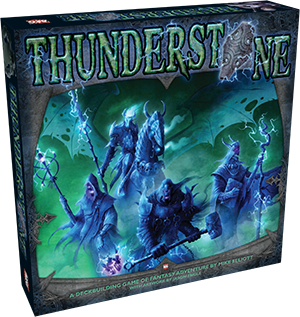
Thunderstone - a really fun deck-building card game

I'm becoming more and more enamored with board games of varying stripes, and diligently looking to see if I can find some electronic versions of well-loved games for my iPad. Since my post on the deck-building game Ascension, I've been playing that online with a friend almost non-stop. It really has increased my interest in deck-building games (and I still suggest that you friend me on Apple's Game Centre so we can play).

Wednesday night, I met with the Kitsilano Board Game group for the second time since I joined. We had a great three hours of gaming with quite a number of games to choose from. Everything from San Juan to Factory Fun (a game that I discovered last meeting that I *cannot* play because it involves having to picture how things can be laid out in a very quick fashion. Since I have no relative spatial ability whatsoever, I quickly became overwhelmed) and even Settlers of Catan.

You can see the large number of choices here.

Click for larger view. And yes, that's my beer, though that's not me in the picture.

I ended up playing this interesting-looking deck-building card game called Thunderstone, though.

The idea behind Thunderstone is that you are an adventurer who has come to a village where there are caves nearby. Buried in the caves is the Thunderstone, a stone of immense magic and power. But it's guarded by hideous monsters.

You can hire mercenaries and buy supplies in the village to help you in your quest.


At the beginning of the game, you have twelve basic cards (some militia, some light sources, and some food) and you are dealt six of them. You can either choose to go to the village and buy one card with the gold value in your hand, or you can go into the dungeon and kill a monster if you have enough attack points in your hand.

Be careful, though. There are three monster cards dealt out, and each one requires one extra light source or you will have an attack penalty.

The third option is to rest, and that allows you to destroy one card in your hand. This can come in handy when you have more cards in your deck, because you want to weed out the riff-raff that doesn't help you much (or perhaps one of the monsters gave you a disease card, which has a -1 Attack and should be destroyed ASAP).

At the end of each turn, all six cards are discarded and you draw six more. Any monsters you have killed or village cards that you've bought are put in your discard pile and will show up again once you have shuffled your deck.

Monster cards are replaced in the dungeon as they are killed, and eventually the Thunderstone will show up. Once the stone reaches the first level of the dungeon, the game ends and victory points are tallied (from monsters that you've killed). The one with the most victory points is the winner!

It may sound a little confusing just from the description, but it's incredibly easy to learn once you have it in front of you, though that does require somebody who knows the game as well. The rulebook can be a bit off-putting. However, with the owner of the game explaining things, I understood everything perfectly within a couple of turns. I even caught her on a misinterpretation of a card or two!

It's an incredibly fun game, and there are a bunch of expansions for it already (I'm not sure how many expansions she had), so the cost can build up. But if you are a gamer (and have the room to store all these games), it's a must-buy.

There is even a free Facebook version of the game that will allow you to play either against AI opponents or against your friends! Just search for "Thunderstone" on Facebook.

There is an iOS app too, but unfortunately it's for the Facebook game and not its own game. I hope they rectify that, but I get the feeling that won't be happening any time soon.

However you play, I do highly recommend it.

Friday, 4 January 2013

Star Trek: DS9 - Ep 15 - If Wishes Were Horses

One of our greatest qualities as humans is the capacity for imagination. There is nothing too big or too small that our brains can't create it for us. Possible or impossible, it doesn't matter. What happens when that imagination runs away from us, though? Sometimes people live only in their imaginary world and can't face reality. And sometimes, our imagination becomes real, and then what do we do? "If Wishes Were Horses" is an episode about imagination, and the consequences of an imagination run amok. It also is a relative stinker of an episode, with iffy acting and a silly plot.

We start the episode with a conversation between Quark (Armin Shimerman) and Odo (Rene Auberjonois) about the qualities of imagination, and how Odo doesn't have one. We then cut to Dr. Bashir (Siddig El Fadil) once again trying to pick up Dax (Terry Farrell). Hasn't he learned by now? He's at his most annoying yet again in this scene. Anyway, Dax then goes to Ops and discovers some strange particles around the station, but no real anomalies. We then cut to Chief O'Brien (Colm Meaney) reading the classic story of Rumplestiltskin to his daughter Molly (Hana Hatae).

Suddenly, there are manifestations of Rumplestiltskin (Michael John Anderson) and Buck Bokai (Keone Young), who is Sisko's (Avery Brooks) favourite baseball player appearing before them. There's also a nice submissive Dax for Bashir. It seems that something is causing everything that people imagine to manifest itself on the station. There's a snow storm on the promenade, Quark has two babes on his arm, and many other things. What's causing this? And will the crew have time to worry about it when a subspace rift forms and threatens to engulf not only the station, but the entire Bajoran system?

Right off the bat, I knew this was going to be a sub-par episode. The opening scene between Odo and Quark, usually the most reliable duo on the show, falls flat. It has a little bit of spark, but not the usual one that these two actors generate off of each other. There are more scenes between the two, and most of them get worse, as if the actors saw how silly the entire script was and decided to phone it in. The main exception to this is when we see Odo's imagination finally manifest itself, with Quark in a holding cell. The look on Odo's face was priceless.

Bashir is at his most annoying, especially in his opening scene with Dax. I know he has a certain arrogance, and his pursuit of Dax indicates somebody who can't take no for an answer. But El Fadil overplays it during his conversation with her, especially the "oh, you're killing me" line when Dax is telling him how good of a friend he is. I don't like him when he's being portrayed as the lady-killer. I also don't buy his fantasy. I can seem him wanting an over-sexed Dax who would be on him all the time. But a dumb one? Bashir values intelligence, and I can't see him wanting a woman who wasn't. So every time the imaginary Dax was on the screen, I felt myself scoff hard (and believe me, that can be painful).

The guest acting was also very questionable, with Young worse then Anderson (though neither were that much to write home about). I don't think Young handled being the spokesman very well, and his attempts to show wonder at suddenly being real went nowhere. Anderson isn't too bad, but he wasn't that great, either. Even the regulars weren't really that good, though Meaney was as good as he always is.

Finally, there were plot problems. Besides the inherent silliness of the plot itself, there were other questionable things. There didn't appear to be any bad imaginary episodes going on. The birds on the promenade were just annoying (and it annoyed me to watch Odo try to herd them, too). The only minor problem that manifested itself was the burning man that Kira encountered (even that came out of left field, as I have no idea why she would have been imagining something like that at that moment). Surely, in a station filled with people, somebody had to be having bad thoughts? Not that we could tell.

There was one good scene (besides the Odo smirk mentioned before). When Quark comes along with the two babes on his arms and tells Odo not to hurry in solving the problem as he's have a wonderful time with the ladies, the look on his face when Odo reminds him that all of the Dabo players are winning, running Quark into the poorhouse is also wonderful. It really shows that, no matter how much Quark likes sex (like any Ferengi, of course), money is the most important thing. While I do think Shimerman overplays the end of the scene a little bit, I thought it was great. Again, though, two scenes don't make an episode.

A story about our imaginations has endless possibilities. Unfortunately, some are good and some are bad. This particular episode was a bad one. It made a mockery of some characters and was just boring for the rest of them. None of the actors looked engaged.

Give this one a pass.

Memorable Quotes

"How is our young doctor, Dax?" "Young." Sisko and Dax

"I must ask you to refrain from using your imaginations." Odo

2 Stars

Thursday, 3 January 2013

Free Association Thursday - A Pleasantly Disturbed Diversion

Isn't free association a wonderful thing? Digging down deep into your self-conscious mind, that sometimes barren and sometimes fruitful area of your mind that provides so many great stories. Along with many bad ones.

That animal part of the mind (is it called “animal?” I don’t know) where we don’t always like to delve, but sometimes can’t help it. Are there stories just waiting down there to be revealed by the feel of your mental shovel clanking against it? Hidden gems that just need a brush to wipe all the grit and grime away? And is this what they mean by a “gritty” story?

I keep hoping that there are some gems down there for me to discover. Ones that don’t require a lot of work to shape. Of course, if that were the case, publishing them would probably be considered something else: plagiarism.

Because really, if they’re already that fully-formed, most likely they’re from somewhere else. The subconscious is a place for nuggets and gemstones, but they’re not just sitting out there on a pillow. They have to be mined, dug out with the sweat of the brow (maybe best left figuratively, unless it’s 100 degrees outside) and then shaped into something good.

It’s almost like those Pleasantly Disturbed posts I did a year or two ago. Just letting the mind wander, not restricting it at all. Letting it off the leash and hoping that it’s trained well enough that it won’t go jumping off after some stray pun or something and never come back. It can point to a great pun and lead you to it, but it shouldn’t go off on it’s own.

You don’t want it to be brought back to you by Animal Control, do you?

The other thing to be concerned about with regards to minds wandering is whether or not they get lost in the metaphorical forest and can never make their way back to you. It’s a tragic thing when the mind is so far gone because it made the left turn at the massive oak tree instead of the right turn. In that case, you can only hope that it will eventually find its way either back home or to a kindly farmer who will see the tag around its neck and bring it back to you.

Really, a mind is a terrible thing to lose.

All that being said, a wandering mind can definitely be a good thing. Remember that old adage “if you love something, set it free. If it loves you, it will return to you?” Ok, maybe not a good analogy for a mind, because how can your mind not love you?

I know what you’re thinking. What about those who have image issues with themselves, or don’t think they are worth anything? The emotional areas of your brain are telling you that, but can you really say it’s your mind? The part of you that thinks?

Then again, maybe this is all coming about because I let my mind wander and it’s already wandered off, sniffing in the bushes and not coming when I call it?

A successfully wandering mind will often come full circle, reaching the beginning point, as if you were able to attach the leash back to it and lead it back home. At least it will if you’re going to use it for anything (like a blog post!). If it doesn’t lead you back to the beginning, then you may want to actually go find it.

Because it’s lost.

And you don’t want a mind that’s lost. You just want one that comes when you call it, but otherwise leaves you alone.

Alone to free associate as much as you want.

(This is almost completely unedited, just taken as it flowed. Which can be dangerous to post, but I think free association exercises like this are great ways to spark the writing process. It's something I want to keep doing to maybe get myself writing again, though I won't necessarily publish them)

Wednesday, 2 January 2013

Book Review - Lightspeed: Year One edited by John Joseph Adams

As stated in yesterday's post about Lightspeed magazine, the e-magazine full of great science fiction and fantasy stories, there was an anthology put out of every story published in the first year of the magazine. Lightspeed: Year One was a huge trade paperback (at least when I read it, though I see the Kindle version is almost half the price of the paperback right now) that was full of great stuff.

Not sure why there isn't a Lightspeed: Year Two out, which I just realized should have come out in November if they were going to do an annual thing. Maybe it didn't sell? I hope that's not the case.

Anyway, the first anthology has some wonderful stuff in it from a wide range of authors, even including an older story from Stephen King. Some well-known names in the genre are reprinted here, such as Bruce Sterling and Robert Silverberg.

The reprints are worth it in themselves, but then you have all of the great new stuff! Stories like the exquisite "Eliot Wrote" by Nancy Kress, wondering whether our memories help make us who we are, and what happens if some of those memories are taken away?

Here's my review of the book on Curled Up With a Good Book.

From the review:
"The problem with putting everything out there in book form, however, is that there will inevitably be some stories that don't work for some people. I used to subscribe to two or three SF magazines, and there was always the occasional clunker. No magazine is perfect, and tastes range too much for this type of anthology to ever achieve a five-star rating. For every story that has tons of fans, there will be somebody who doesn't like it. And while you can recognize the quality of the stories, that doesn't mean they'll all work for you.

That said, this is an excellent collection of old and new stories from some of the biggest names in SF writing (and even non-SF, as Stephen King has a science fiction story here). Each issue of the magazine features an old story and a new one, so you will be reading some classics. Yet the editors don't go for the easy ones. I've read a lot of SF, and all but a couple of these stories were still new to me (one wasn't due to its inclusion in a "best of the year" anthology that I had already read). Most of these are excellent, too."
Yes, there are a few clunkers in here that did nothing for me, but the hit/miss ratio is so huge that it's well-worth getting.

I highly recommend this volume of stories (the non-fiction from the magazines has been removed so it's a book of just stories) if you want to catch up on some great science fiction.

And then subscribe as I recommended yesterday.

You know you want to.

Tuesday, 1 January 2013

Lightspeed Magazine - For Those With Fantastical Tendencies

Yes, I realize this is the October issue.
I liked the art. So sue me.
E-books and e-magazines are becoming the wave of the future. While many outlets are available in multiple formats to please all reading types, magazines exclusively available online are becoming more and more popular. It saves on printing costs, among a host of other benefits.

Lightspeed is one of those exclusively online magazines. You can read many of the stories for free on their web site, but subscriptions are available through Amazon and many other means. This will get you all of the stories at once at the beginning of the month, rather than scattered throughout the month. It will also get you some exclusives that aren't available on the site. One of the first things I did when I first had my new Kindle Fire was to get a subscription.

It also is a mix of old and new, as they have managed to find some classic stories to publish in addition to highlighting new authors and stories. They've recently merged with Fantasy magazine to encompass both Fantasy and Science Fiction, which makes me happy (I'm a big fantasy fan).

I first became familiar with Lightspeed magazine after V-Con #36, the annual science fiction convention up here in Vancouver. I met author Sandra Wickham there, which led to me eventually following her Twitter feed, and then seeing that she was a slush reader for Lightspeed ("slush" basically just means unsolicited story manuscripts that a number of people involved with the magazine read to see if they would recommend publishing them).

I hadn't really hit the e-book phenomenon at that time yet, so didn't think much of it. It was interesting, and a potential new market to look at if I ever got up off my ass and wrote something, but that was about it.

Then Lightspeed: Year One hit, the first (I assume it will be annual) anthology of every story to have appeared in the magazine during their first year of publication. Watch for my review of the book to show up tomorrow, as I just realized I never posted it here.

Suffice to say, it gripped me enough that I didn't want to wait for each anthology.

Yet for some reason, I didn't bite the bullet and subscribe. Perhaps it was a misunderstanding on my part that the magazine would have a few more graphics than it actually does (namely, it has none that I can see), and thus I didn't want to get it when I had the old basic Kindle where pictures don't come across at all well.

Whatever the reason, while I wanted to do it, I just didn't.

I've now rectified that.

It's a steal at $2.99/issue ($3.99 if you buy issues separately, still not a bad price). Even better, you don't pay the subscription in one lump sum. You pay $2.99/month, not $36/year. Makes the hit seem better when it shows up on your credit card statement.

Not to mention that the first issue is a free trial, so you can cancel if you want.

What's not to like?

I've now finished my first issue (December 2012, Issue #31), and I have to say I loved it.

Stories by Marta Randall, Ken Liu, Yoon Ha Lee, and many others. A great interview with Tad Williams. The only story I didn't read was Kelly Link's "Catskin," and that's not because I didn't like it or don't like her writing. I've just read it so many times that I didn't want to read it again this time. (Yes, it's one of the reprints)

I'm looking forward to keeping up my subscription and receiving 80,000 to 85,000 words of wonderful fantasy and science fiction downloaded to my Kindle every month.

It will be like a birthday every month.

I highly recommend Lightspeed magazine. With one month free to try it, how can you go wrong?